
Properties have employed spray foam insulation to enhance thermal performance and minimise undesired air movement. Insulation can play a significant role in a property’s overall energy efficiency plan provided it is properly specified and put in the right place. However, there are situations in which the current spray foam may need to be evaluated, fixed, or eliminated.
Knowing when spray foam removal may be required is a crucial first step for homeowners who are worried about the suitability or quality of foam insulation. The choice is not always clear-cut because the mere existence of spray foam does not always indicate that it must be removed. It is necessary to take into account its state, location, installation technique, and impact on the nearby building materials.
In certain cases, removal could be advised because the material has been put incorrectly or is creating issues. In other situations, a property owner might need to remove spray foam because inspection, maintenance, or repairs necessitate access to the underlying roof structure.
Why could it be necessary to remove spray foam?
Spray foam removal may be required for a number of reasons. An installation that is not suitable for the building or the specific roof structure is among the most prevalent.
For spray foam to work as intended, it must be applied appropriately. It may cause problems rather than solve them if it has been applied to inappropriate surfaces, installed excessively, or failed to give the desired coverage.
The state of the surrounding materials and roof is also important. The presence of foam may make it more challenging to examine the pertinent regions if there are issues with moisture, the quality of the timber, or ventilation. To thoroughly evaluate the underlying structure in such cases, spray foam removal might be required.
Each property’s unique conditions determine the best course of action. An examination can assist in determining whether removal is indeed necessary or if an other approach could be more appropriate.
Indications that the installation could require maintenance
There are a number of reasons why existing spray foam may worry homeowners. Questions concerning whether spray foam removal should be taken into consideration may arise from visible deterioration, alterations in the roof space, or indications of dampness.
Modifications to the state of roof timbers could be especially significant. It is necessary to determine the underlying reason if there are indications of wetness, rot, or other degradation. If insulation obstructs proper examination or access, it may need to be removed rather than just considered to be at fault.
Unusual smells, obvious dampness, or stains may also call for additional research. These indicators may suggest that a closer examination of the building is necessary, but they do not necessarily imply that the spray foam is flawed.
In general, it is preferable to look into issues as soon as possible rather than waiting until a small problem grows into a bigger one.
Removal may be due to poor installation.
The performance and applicability of spray foam can be significantly impacted by how it is put. Application necessitates careful consideration of the substrate, the building structure, and the insulation’s intended use.
In the end, spray foam removal can be necessary if the substance was applied improperly. Issues may occur if foam is applied inconsistently, if the quantity of material utilised is improper, or if foam has been placed where it shouldn’t be.
Inadequate installation may also complicate maintenance in the future. Excessive or inappropriate foam can obstruct roof structures’ ability to be inspected and repaired.
Whether the installation satisfies the needs of the specific property and whether removal is required can be ascertained with the aid of a professional evaluation.
When a roof needs to be repaired
Another reason to think about spray foam removal is roofing issues. Contractors may need access to insulated regions if a roof needs major repairs.
Sometimes the required access can be obtained by simply removing portions of foam. In some circumstances, especially when the insulation covers a significant portion of the roof structure, more thorough spray foam removal can be necessary.
The amount of removal should be determined by what is required for a safe structure inspection and repair. Unnecessary insulation removal can increase expenses and cause disturbance, while neglecting to remove material that prevents critical repairs might lead to problems down the road.
Therefore, if extensive roof work is being planned, planning ahead is crucial.
Roof timber concerns
Many properties depend heavily on roof timbers, so it’s important to keep an eye on their condition over time. This might become an issue when insulation makes it challenging to adequately evaluate wood.
Spray foam removal may be required to give clearer access if there is evidence that the wood may have been impacted by moisture or degradation.
Differentiating between a verified structural issue and an access concern is crucial. Spray foam is not a sufficient indicator of compromised roof timbers.
An appropriate inspection can determine whether a problem exists and what needs to be done. When removal is necessary, it can enable a more comprehensive evaluation of the underlying structure.
Considerations for ventilation and moisture
Any roof space must take moisture management into account. While ventilation may be necessary for some roof constructions, buildings must be built and maintained to effectively regulate moisture.
Further research may be required if the installation of spray foam interferes with the intended ventilation or raises questions about moisture control.
Spray foam removal may be a component of the solution, depending on the results. The roof’s construction, the insulation’s state, and the particulars of the issue will all determine the best course of action.
The problem might not be solved by merely removing insulation without addressing the underlying cause. The entire roof system must be taken into account.
Issues in remortgaging or selling a property
Homeowners who intend to sell or remortgage their property may also look into spray foam removal.
During property surveys, appraisals, or lending procedures, insulation-related questions may come up. The homeowner might need to get further details about the installation if the spray foam’s existence or condition raises questions.
Removal may be taken into consideration in certain situations in order to prepare the property for sale or to resolve issues brought up during a survey. However, just because spray foam is present doesn’t mean that removal is always required.
The specific situation and the needs of the pertinent parties determine the best course of action.
Is it necessary to remove all of the spray foam?
No. It is not always necessary to remove spray foam when it is present.
There may be insulation on a property that works as planned and doesn’t cause any issues. Eliminating it needlessly might result in more costs and inconvenience without offering a commensurate advantage.
For this reason, before choosing a choice, an evaluation is crucial. It is important to take into account the material’s position, state, installation, and connection to the surrounding structure.
There might not be a need to remove the insulation if no issues have been found. However, removal might be a suitable step in resolving serious issues.
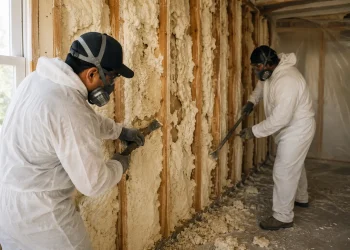
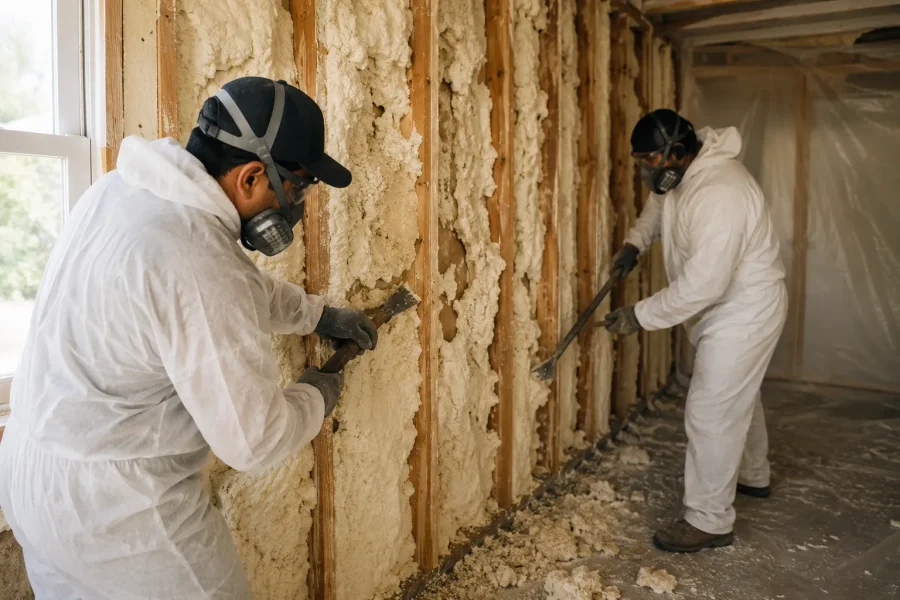
What is involved in removing spray foam?
The method and location of the material’s installation determine the precise procedure for removing spray foam.
Because the foam may be securely adhered to the surface underneath it, removal can be labour-intensive. It is important to minimise needless harm to the underlying structure.
Working cautiously throughout the impacted area and gradually eliminating the debris may be part of the procedure. The substrate’s state must be taken into account at every stage, especially if the foam has been placed directly on roof components.
Before inspection, repair, or replacement work can begin, more cleaning or preparation may be required after the insulation has been removed.
The size of the impacted area and the initial foam installation method will determine the project’s scope.
After removal, what happens?
Removing spray foam is not always the last step in solving an issue. The underlying roof or building structure may need additional evaluation after the material has been removed.
This can highlight problems that were previously hard to spot, like places that need repair, moisture-related difficulties, or damaged lumber.
The next step might be to think about an alternate insulation strategy that is suitable for the building if the roof is determined to be in good condition.
Any replacement insulation must be chosen with the property’s construction and ventilation needs in mind. Instead of being viewed as a stand-alone commodity, insulation should be a component of a well-thought-out construction system.
Do you need to do the spray foam removal yourself?
If only a tiny area seems to be impacted, homeowners could be tempted to try spray foam removal themselves. However, removing insulation that has been securely bonded can be physically taxing and may require working in challenging roof locations.
If the wrong equipment or methods are utilised, there is also a chance that the underlying structure will be harmed. Furthermore, homeowners might not be able to identify if an apparent issue is specific to the foam or extends to the building or roof beneath it.
For these reasons, expert evaluation and suitable removal techniques may be preferred, especially in cases where the insulation covers a large area or the roof structure is a problem.
How to determine if removal is required
Rather than making assumptions about spray foam in general, the decision to remove spray foam should ideally be based on the state and circumstances of the property.
An evaluation can help determine what is truly going on if there are indications of dampness, degradation, shoddy construction, or difficulties gaining access to the roof structure.
Homeowners should think about the reasons behind their relocation plans. The quantity of access needed may dictate how much material needs to be removed if the purpose is a planned roof repair. Getting precise information regarding the installation could help determine the best course of action if the issue is related to a survey or property sale.
By being methodical, one can avoid needless work and make sure that real issues are handled properly.
The significance of solving issues early
Delaying an evaluation could make fixing an underlying problem more challenging or costly if there are worries about a roof or insulation.
This does not imply that every issue calls for spray foam removal right away. Rather, it emphasises how important it is to comprehend the property’s state before determining the best course of action.
More clarity regarding whether the insulation is causing an issue, whether access is being impeded, or whether the underlying roof needs maintenance for another cause can be obtained by early research.
Making a knowledgeable choice
In the end, spray foam removal may be required in specific situations, but it shouldn’t be considered a must whenever spray foam is discovered on a property.
Removal may be justified by poor installation, limited access, moisture concerns, roof repairs, and challenges examining underlying materials. But before a choice is made, the property’s unique circumstances must be evaluated.
The best course of action for homeowners is to assess the state of the surrounding structure and insulation, identify the issue that needs to be fixed, and decide whether removal is truly necessary.
Careful planning can reduce disturbance and safeguard the underlying structure when spray foam cleanup is required. The roof can be evaluated more carefully after the material has been removed, and any required upgrades or repairs can be taken into consideration.
Understanding the building’s overall state is more important than just concentrating on getting rid of the foam. Homeowners can make smarter decisions regarding the future of their roof, insulation, and property by approaching spray foam removal thoughtfully.