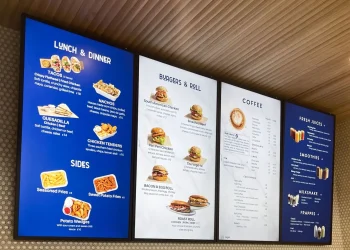


In the present day, it is becoming more probable that you will be greeted by a vibrant, illuminated digital screen rather than a printed menu or a handwritten chalkboard when you enter nearly any food outlet, including a high-street burger joint, an independent coffee shop, a motorway service station, or a bustling food court. Digital menu displays are rapidly becoming one of the most visible changes in the food service industry, and their adoption is accelerating at a remarkable pace. However, what is the reason for the pervasive transition from traditional static displays, and why are so many food businesses making the switch?
The Economics of Flexibility
The operational flexibility that digital menu boards offer is one of the most compelling reasons that food outlets are investing in them. In the past, the process of updating a menu involved the reprinting of boards, the replacement of printed inserts, or the repainting of chalk displays, all of which required time, money, and effort. A business can update its complete menu offering in a matter of seconds from a central system with digital menu boards, whether that means introducing a new seasonal special, removing a sold-out item, or adjusting prices.
Profitability is substantially affected by this adaptability. During periods of inflation or supply chain disruption, food businesses operate in an environment where ingredient costs can fluctuate substantially. Operators can promptly adapt to these modifications through digital menu boards, which eliminate the delays and expenses associated with conventional printed materials. A restaurant that was previously compelled to incur a loss due to outdated pricing on its printed menus can now update its prices instantaneously and safeguard its margins.
Dynamic Content and Dayparting
The sophisticated practice of dayparting, which involves automatically displaying various menus at different times of day, is made possible by digital menu boards in addition to basic price changes. In the morning, a café may present its entire breakfast menu, transition seamlessly to a lunch menu at midday, and then promote afternoon tea options in the early evening, all without the need for manual intervention from staff. This type of automated content scheduling guarantees that consumers consistently view the most pertinent offering at the most appropriate time, which has a quantifiable impact on sales.
In addition, digital menu boards enable food outlets to more effectively promote limited-time offers and upsell items than static displays. The customer’s focus is captured by animated graphics, rotating promotions, and eye-catching visuals in a manner that a fixed printed board cannot. Dynamic visual content consistently increases dwell time and encourages customers to investigate a broader range of menu items before making a decision, according to research on customer behaviour. These incremental increases in average transaction value can have a substantial impact on culinary businesses that operate on narrow margins over time.
Adherence to Nutritional Regulations
In recent years, the regulatory environment that food enterprises have encountered has become more stringent, particularly in terms of the display of nutritional information. Menu administration has been further complicated by legislation mandating that outlets exceeding a specific capacity include calorie counts on their menus. These requirements are being met by digital menu boards, which are proving to be an invaluable tool. They can be centrally updated to reflect any changes in recipe or portion size, ensuring that the information displayed to consumers is always accurate and legally compliant.
The procedure of maintaining current nutritional information on printed menus is both time-consuming and costly. This burden is wholly eliminated by digital menu boards, which offer a simple solution for compliance without the ongoing expense of reprinting. A digital infrastructure in place provides food outlets with a substantial advantage in adapting rapidly to new requirements as regulations in this area continue to evolve.
Decreased Perceived Wait Times
There is a well-established psychological principle that is at play in crowded food outlets: consumers who have something stimulating to observe while they wait perceive their delay as shorter than it is. Digital menu displays are exceedingly effective in fulfilling this function. Digital displays ensure that customers remain informed and entertained during what could otherwise be a frustrating delay by presenting dynamic content, such as an animated showcase of culinary items, promotional messaging, or general lifestyle content pertinent to the brand.
This decrease in the perceived wait time has tangible advantages for customer satisfaction scores and, consequently, for repeat business. Food outlets that have implemented digital menu boards frequently report an increase in customer feedback, with visitors expressing their satisfaction with the venue’s overall experience. In a competitive marketplace where consumer loyalty is both hard-earned and easily lost, these enhancements to the in-store experience are of significant commercial significance.
Waste Reduction and Sustainability
Consumers are increasingly scrutinising the environmental credentials of the brands they endorse, which is why sustainability is becoming an increasingly significant factor for food businesses. By eliminating the ongoing requirement for printed materials, digital menu boards make a substantial contribution to the sustainability initiatives of a food outlet. The paper, plastics, and inks that are utilised in the production of traditional menus and promotional boards are a perpetual source of waste. However, digital displays render this waste wholly superfluous after the initial installation.
The break-even point, at which the digital solution becomes the more sustainable option, is reached relatively rapidly due to the long operational lifespan of modern commercial-grade displays, despite the fact that the manufacture of digital screens does have its own environmental imprint. This transition to digital menu boards is now being incorporated into the broader environmental commitments of numerous food businesses, and they are communicating this decision to consumers as evidence of their dedication to responsible operation.
Integration with Ordering Technology
Self-order terminals, mobile ordering platforms, and kitchen management systems have all been widely adopted in recent years, resulting in a substantial technological transformation of the food service industry. This broader digital ecosystem is seamlessly integrated by digital menu displays. For instance, when a menu item is sold out, it can be automatically removed from both the digital menu boards and the self-order kiosks simultaneously, thereby preventing consumers from ordering items that are no longer available.
Additionally, this type of integration facilitates more advanced inventory management. By linking digital menu boards to back-of-house systems, food outlets can establish an authentically responsive environment in which the information presented to consumers at any given moment accurately reflects the available options. In larger operations with multiple outlets, the centralised control of digital menu boards ensures consistency of messaging and pricing across all locations, thereby reducing the risk of errors and the administrative overhead associated with managing multiple sites independently.
Training and Staff Efficiency
The positive influence of digital menu boards on staff efficacy is a frequently disregarded advantage. Team members are relieved of the necessity to manually alter boards, remove outmoded price labels, or address customer complaints regarding discrepancies between advertised and actual prices when menus are updated digitally. The staff can concentrate on providing exceptional customer service rather than on administrative responsibilities associated with menu maintenance.
Staff training is also facilitated by digital menu displays. The full menu offering can be rapidly familiarised by new team members by perusing the displays, and any changes to the menu are instantaneously visible to all staff without the need for separate briefings or printed update sheets. This reduction in friction is a tangible and practical benefit in high-turnover environments, where the task of training new staff is a constant operational challenge.
Investing Case
The primary hesitation for food enterprises that have not yet made the transition is frequently the matter of cost. A substantial initial investment in hardware, installation, and content management software is necessary for digital menu displays. Nevertheless, the return on that investment is becoming more thoroughly documented. The payback period for a digital menu board installation is frequently shorter than operators initially anticipate when businesses consider the ongoing savings on printed materials, the uplift in sales driven by dynamic content, the improvements in operational efficiency, and the benefits of regulatory compliance.
The digital menu board technology market has also matured significantly, resulting in a significant expansion of the options available to culinary businesses. There are solutions available to accommodate operations of all sizes, ranging from a single-screen installation in an independent café to a complex multi-site network that spans dozens of locations. The adoption of digital menu boards has transitioned from being a distinguishing feature of forward-thinking businesses to an anticipated feature of a modern, well-managed food outlet as the technology has become more accessible and the evidence of its commercial impact has grown substantially.
Prospective
There are no indications that the momentum behind digital menu boards is slowing down. As the integration between digital displays and broader restaurant management systems becomes more profound, as content management platforms become more intuitive, and as screen technology continues to progress, the argument for adoption will only become stronger. The question for food outlets that have not yet made the transition is no longer whether or not to implement digital menu boards; it is when and how to do so in a manner that optimises the return on their investment and provides the best possible client experience.
Digital menu boards have become one of the most influential and versatile tools available to food service operators in an industry where margins are limited, competition is intense, and customer expectations are constantly increasing. Their increasing prevalence is not a temporary phenomenon. It is a testament to the tangible and quantifiable advantages they provide on a daily basis, in every conceivable culinary outlet.