

Sound insulation is the ability of an element in a building or structure to reduce the transmission of sound through it. Two kinds of sound insulation could be described as airborne sound insulation as well as the impact type of sound insulation. It is important to be aware that the weakest component of the structure has a significant impact on the sound insulation overall.
In this post this article, we’ll concentrate on the airborne sound insulation.
The quality of the airborne sound insulation is determined by the following basic rules:
– flexibility/rigidity
– efficiency
– Mass
– isolation.
The effectiveness of any approach to insulation will vary depending on the type of sound but for the vast majority of buildings all the basic principles of insulation apply. Specifics of the basic principles are discussed in the following sections.
Mass
As an example, the average SRI of brick walls can increase from 45 dB up to 50 dB when its thickness increases from 102.5 millimetres to 215 millimetres. The doubling of mass does not have to be accomplished through an increase in thickness, as walls’ mass used for sound insulation is determined through its density, which is measured by kilograms/square metres (rather instead of per cubic metres). Concrete blocks of various density can be produced with the exact same amount of surface area through the different densities in the concrete blocks.
Resonance.
It is the Mass Law states that the sound insulation of a single leaf partition has a linear relation with the density (mass per surface) that the partition and grows according to the frequency of the sound.
Windows and doors are vital elements of a structure, but having a basic understanding of the concept of uniformity will prevent energy from being wasted on installation of insulation at the inappropriate places. To increase the insulation of a structure made of composites, the part with the cheapest insulation needs to be upgraded first off. Walls that are exposed to loud traffic should be made up of only the minimum amount of doors and windows and also be protected.
A frequency doubling corresponds to a difference of 1 Octave. For instance brick walls offer around 10 dB better insulation against sounds of 400 Hz than noises of 100 Hz. The change, which is between 100 and 200 Hz, and following that, 200 to 400 Hz is the result of a two-octave rise.
Insulation levels that are lower or even small gaps in the construction of walls can have a greater impact on the overall insulation than is generally thought. The totality of a structure depends on airtightness , uniformity and airtightness.
Sound insulation rises by about 5 decibels each time the mass is increased by 5 times.
To improve sound insulation design, the most common methods involves expanding the thickness of the masonry, plaster and glass. If a structure is not in compliance with this Mass Law it is due to the fact that additional factors like airtightness, rigidity and isolation also are influencing the construction.
Efficiency.
Single-leaf construction also includes composite structures like brickwork that has been plastered, so long that the layers are joined together. The theory suggests an increase in insulation of 6 decibels for every doubled mass, but for constructions that are practical, this rule of thumb is preferred.
Common air gaps:.
Wall-floor gap.
Gaps in doors.
Window seals aren’t good enough.
Pipes with no seals.
Cables that are not sealed.
Permeable blockwork.
Isolation.
The loss of insulation due to resonance occurs when the sounds have exactly the identical frequency to the normal frequency for the part. The higher frequency of vibrations taking place within the structure get transmitted to the atmosphere, and the insulation decreases. Resonant frequencies tend to be low , and are likely to cause issues in the air zones of the cavity construction.
Airtightness.
The total sound insulation of a building is significantly diminished by tiny areas that have low insulation. A door that is not sealed and occupies 25% of the surface of a half-brick wall reduces its average SRI of the wall by approximately 45 dB to around 23 dB. Sound insulation can be affected by the relative location, but it is always more in line with what is insulated by the less insulated component than that of the higher part.
The efficacy of sound insulation is determined by frequency, and the Mass Law likewise predicts the above list of effects on frequency.
Mass Law.
. Structures that are heavy and have a high mass emit lower levels of sound than light structures. The denseness of heavier materials limits the amount of sound waves inside the structure, resulting in the last face of the building, for instance the walls inside the room, is vibrated with less energy than the lighter-weight materials.
The flexible (non-stiff) substances, paired with a substantial mass are ideal for high-sound insulation. It isn’t an ideal structural feature in a wall or floor.
Coincidence.
Some materials could be fluid enough to let sound through the tiny gaps in their structures; blocks and bricks should be plasterized or sealed. Doors and windows that are openable ought to be airtight after closing and the kind of seal used to improve thermal insulation can also be used to block out sound.
The amount of sound insulation increases by 5 decibels each time the frequency is increased by a factor of 2.
When the amount of insulation against airborne sound increases, the number of cracks becomes more significant. For example when a brick wall is characterized by cracks or holes which in its size is just 0.1 percent of the total area that the wall covers, then the average SRI of the wall has been decreased from 50 dB down up to 30 decibels.
Examples of frequency:.
100 Hz = bass note.
400 Hz- 2 kHz = voice.
Sound isolation can be damaged by the strong side-to-side transmissions of linkages that are rigid, as simple as just one nail. Cavity structures need to be wide enough so that the air can be flexible, as resonance and other effects of coincidence can result in the insulation being diminished at specific frequencies.
Uniformity.
In the process of transforming the sound to various wave patterns at the junction of different materials the energy is lost and a significant amount of insulation is created. Some concert buildings and broadcasting facilities achieve very high levels of insulation using a completely non-linear construction of a double structure , separated by a resilient mounting.
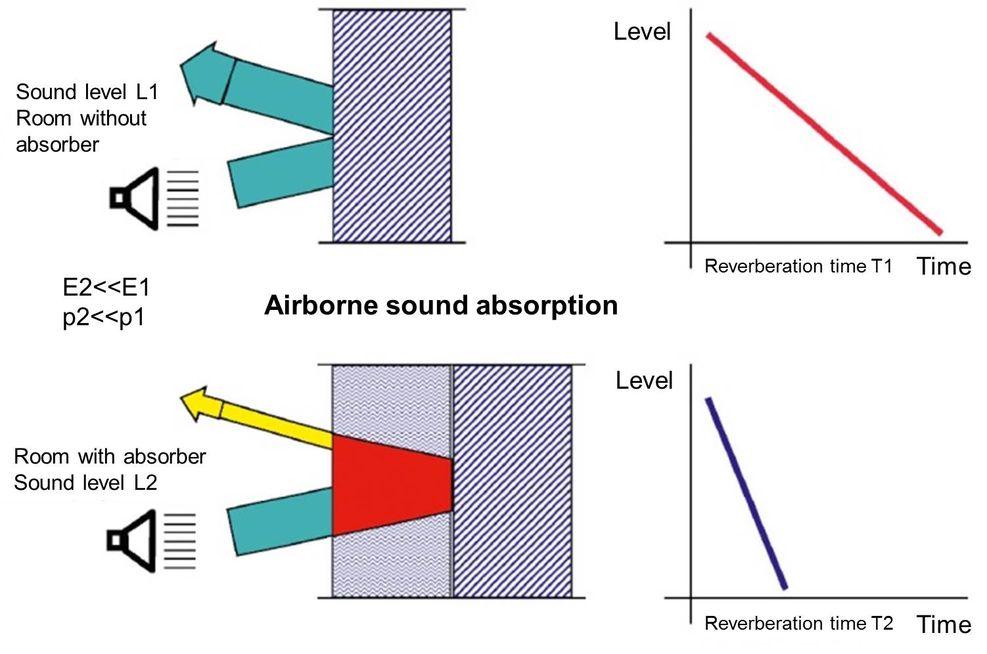
Because the vibrations generated by this “loudspeaker” effect are limited, the power of the acoustic wave that is re-radiated into the air is reduced. A reduction in the intensity of sound waves affects the’strength’, or ‘loudness of a sound. However but it doesn’t affect its frequency (pitch) of the sound.
The loss of insulation due to coincidence is caused by vibrating flexural vibrations that may occur across the length of the partition. If you are able to get several octaves higher than this threshold frequency, the sound insulation is likely to remain continuous, and lower than what is predicted according to The Mass Law.
Flexibility.
Stiffness is a physical characteristic of a partition that is dependent on factors such as its elasticity material and the repair of the partition. A high degree of stiffness could cause the loss of insulation in particular frequencies when resonances and coincidence effects. These causes can alter the assumptions that are derived from the Mass Law.

Making Every Screen Count: A Guide to Effective Digital Signage
Maximising your signage space is crucial for organisations aiming to attract attention, convey messages clearly, and stay competitive in a...